- Back to NEWS & VIEWS
- Research Reports
- 16/06/2022
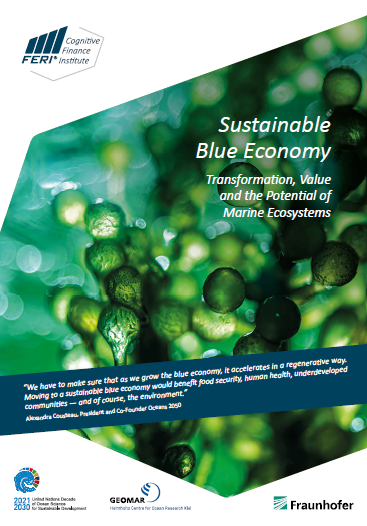
Sustainable Blue Economy: Transformation, Value and the Potential of Marine Ecosystems
“We have to make sure that as we grow the blue economy, it accelerates in a regenerative way. Moving to a sustainable blue economy would benefit food security, human health, underdeveloped
communities, and of course, the environment” – Alexandra Cousteau, President and Co-Founder Oceans 2050
The world of the 21st century is not only marked by major geopolitical turning points but also by the massive effects of man’s destructive interventions in nature. The resulting issues and repercussions for humanity itself are currently being felt more and more clearly. The progressive climate change and the resulting extreme weather disasters are only “the tip of the iceberg”.
New strategies for a more sustainable and at the same time more efficient use of natural resources are necessary and force radical changes in perspective. The so-called “blue economy”, which summarises all economic activities in the marine ecosystem, has an important role and function as it guarantees the life and existence of humans. It also forms the basis of a globalised economy, especially through transport and energy production, as well as protein supply for a large part of humanity.
The importance of the oceans is not only based on the extraction of marine resources, but also in the control of the global climate through CO₂ absorption and oxygen production, which is often still underestimated.
Global research projects and technological solutions are now subsumed worldwide under the term Sustainable Blue Economy.
At the same time, numerous initiatives are forming the basis for a new political and regulatory agenda. From the UN SDG published in 2015 on the reorientation of state action to the current EU taxonomy as a common classification system for financing sustainable growth in Europe, states and politicians are striving to lay the foundations for an economic rethink and
a change of direction.
Not only the industries of the Blue Economy but also the global financial industry in particular have an important role to play in the global transition. The long-term financing of new technologies, large-scale marine infrastructure projects as well as massive structural changes in both fisheries and marine logistics require economic incentives and new regulatory foundations for investors.
The global megatrend of sustainable investment supports efforts to achieve an economically sensible and at the same time ecologically responsible transformation towards a Sustainable Blue Economy. The technological and regulatory changes will create challenges and opportunities by disrupting traditional systems. Strategic investors should be aware of the opportunities of a Sustainable Blue Economy and its potential for environmental, social, and economic change.
The purpose of this study is to consider the interdependencies of ecological, economic, political, and social factors. In addition, the explanations that follow are intended to highlight central ideas, drivers, and impact mechanisms behind the (financial) potential of a Sustainable Blue Economy as an answer to pressing challenges.
Dr. Heinz-Werner Rapp, Founder & Head of the Steering Board, FERI Cognitive Finance Institute
Antje Biber, Head of SDG Office, FERI AG
Dr. Steffen Knodt, Head of the Center for Sustainable Ocean Business,
Fraunhofer IGD
Prof. Dr. Martin Visbeck, Professor for Physical Oceanography,
GEOMAR Helmholtz Center for Ocean Research Kiel and Kiel University